CieTrade Account Hierarchy Integration Guide
A guide for integrating with CieTrade APIs and transforming flat account data into a consolidated enterprise hierarchy.

The Problem
CieTrade's API provides flat account data - each facility is a separate account with no native parent/child relationship. Enterprise customers like UPS (1,538 facilities) appear as hundreds of separate accounts with no connection between them.

What CieTrade Provides
ListAccounts returns:
┌────────────────────────────────────────┐
│ account_id: 7088  │ "UPS - ILBED"      │  ← Separate account
│ account_id: 7089  │ "UPS - ILFRA"      │  ← Separate account
│ account_id: 7090  │ "UPS - ILGAN"      │  ← Separate account
│ ...               │ (1,538 UPS accounts)│
│ account_id: 7310  │ "McKesson DC1"     │  ← Separate account
│ account_id: 7314  │ "McKesson DC2"     │  ← Separate account
└────────────────────────────────────────┘

No way to know these belong to the same enterprise customer!
The account_id values above are realistic examples of the 4-digit CPID format. They are not guaranteed to match exact production values.
The Solution
Build a 3-tier hierarchy by creating a parent account mapping layer on top of CieTrade data.
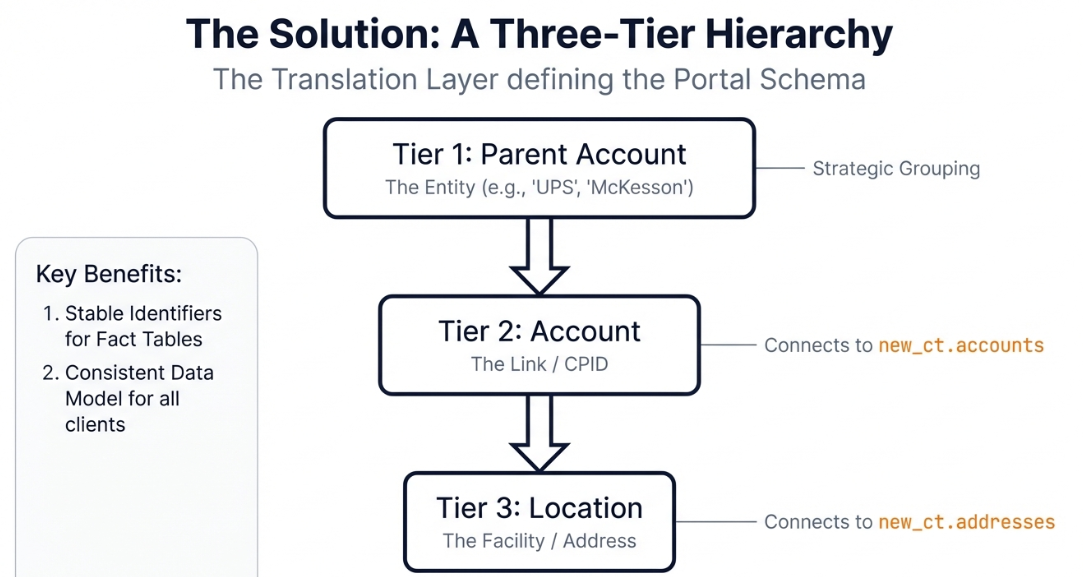
The Three Tiers
| Tier | Source | Purpose | Example |
|---|---|---|---|
| 1 | You create | Parent Account (enterprise customer) | "UPS" |
| 2 | ListAccounts | CieTrade Account (CPID/facility) | "UPS - Bedford Park" |
| 3 | ListAccountLocations | Service Location (address) | Physical pickup address |
Each tier connects to the one above, creating a hierarchy that rolls up data from individual service locations to enterprise parent accounts.
Two Relationship Patterns

Standard (1:1:N)
1 Parent → 1 CieTrade Account → Many Locations
- Used by most customers
- Single CieTrade
account_idper parent - Simple mapping
Complex (1:N:N)
1 Parent → Many CieTrade Accounts → Many Locations
- Used by UPS, McKesson, Sonepar, and other large enterprises
- Multiple CieTrade
account_ids under one parent - Needed when each facility has its own CieTrade account
CieTrade API Endpoints

CieTrade provides 10 API endpoints. Two are Master Data (accounts and locations) that form your hierarchy foundation. Eight are Transactional (services, billing, dispatch, trading) that join to the hierarchy.
Endpoint Overview
| Endpoint | Type | Purpose | Join Pattern |
|---|---|---|---|
ListAccounts | Master | Customer accounts (CPIDs) | Primary key |
ListAccountLocations | Master | Service locations | FK: account_id |
ListServices | Transactional | Scheduled services | account_id + location_name |
ListBillingSheets | Transactional | Billing documents | account_id |
ListBillingSheetCharges | Transactional | Line item charges | account_id + location_name |
ListDispatchJobs | Transactional | Dispatch jobs | account_id + location_id |
TradingInquiry | Transactional | Material trading | account_id + location_name |
ListAccountsReceivable | Transactional | A/R snapshot | account_id |
ListServiceExpenses | Transactional | Service expenses | service_id |
ListWorksheets | Transactional | Operational data | account_id |
Master Data Endpoints
ListAccounts
Returns all CieTrade customer accounts (CPIDs).
| Field | Type | Description |
|---|---|---|
account_id | integer | Primary key - use this to link locations |
account_name | string | Customer/facility name |
role_name | string | Account role classification |
active_status | string | "Active" or "Inactive" |
Record Volume: ~2,516 customer accounts in the Wasteology hierarchy (6,900+ total in CieTrade)
The API returns approximately 20 fields. The table above highlights the most relevant ones for building a hierarchy. account_id is the CPID (4-digit CieTrade-assigned identifier) that serves as the key link between CieTrade data and the Wasteology parent account hierarchy.
ListAccountLocations
Returns service locations linked to accounts.
| Field | Type | Description |
|---|---|---|
location_id | integer | Primary key |
account_id | integer | Foreign key → ListAccounts.account_id |
location_name | string | Location identifier |
address | string | Street address |
city | string | City |
state | string | State abbreviation |
zip | string | ZIP code |
Record Volume: ~15,477 locations (across accounts in the Wasteology hierarchy)
The Native Join
-- CieTrade's native relationship (flat, no parent)
SELECT
    a.account_id,
    a.account_name,
    l.location_id,
    l.location_name,
    l.address, l.city, l.state, l.zip
FROM cietrade_accounts a              -- from ListAccounts
JOIN cietrade_locations l             -- from ListAccountLocations
    ON l.account_id = a.account_id;
Building the Hierarchy
Step 1: The Parent Account Mapping Layer
Wasteology maintains this hierarchy in three PostgreSQL tables in the portal schema:
wg_parent_accounts— One row per enterprise customer (e.g., UPS, McKesson). Contains the parent_account_id and parent name.wg_accounts— One row per CieTrade CPID that has been assigned to a parent. Theparent_account_idFK links each account to its parent.wg_account_locations— Mirrored location data fromListAccountLocations, linked to accounts viaaccount_id.
This mapping is maintained manually. See Data Access for the API endpoint to query the full hierarchy.
Step 2: Join Everything Together
-- Consolidated hierarchy view
SELECT
    p.parent_account_id,
    p.parent_account_name,
    a.account_id AS cietrade_account_id,
    a.account_name AS facility_name,
    l.location_id,
    l.location_name,
    l.address, l.city, l.state, l.zip
FROM wg_parent_accounts p
JOIN wg_accounts a
    ON a.parent_account_id = p.parent_account_id
LEFT JOIN wg_account_locations l
    ON l.account_id = a.account_id
ORDER BY p.parent_account_name, a.account_name, l.location_name;
The Golden Rule of Joining
When joining transactional data (services, billing, dispatch) to the hierarchy, always join on BOTH account_id AND location_name to ensure correct location matching.
-- Joining transaction data to hierarchy
SELECT
    p.parent_account_name,
    a.account_name,
    l.location_name,
    t.service_date,
    t.weight
FROM cietrade_services t              -- from ListServices
JOIN cietrade_accounts a
    ON a.account_id = t.account_id
JOIN cietrade_locations l
    ON l.account_id = t.account_id
    AND l.location_name = t.location_name    -- BOTH fields!
JOIN wg_accounts wa
    ON wa.account_id = a.account_id
JOIN wg_parent_accounts p
    ON p.parent_account_id = wa.parent_account_id;
Why both fields?
account_idlinks to the CieTrade CPIDlocation_namedisambiguates when one account has multiple service addresses- Without both, you may get duplicate or incorrect location assignments
Edge Cases

UPS (Recommended Parent ID: 1197)
| Attribute | Value |
|---|---|
| Pattern | 1:N:N (1,538 CieTrade accounts) |
| Locations | 1,859 |
| Reason | Billing restrictions require separate account per facility |
| Special | Seasonal accounts (PEAK 2023, PEAK 2024) should be excluded |
Example CieTrade Accounts to Map:
- ILBED - Bedford Park
- ILFRA - Franklin Park Hub
- ILGAN - Morgan Street Center
- ILJOL - Joliet
- IL53A - Rockford Air Cargo Facility
McKesson (Recommended Parent ID: 1209)
| Attribute | Value |
|---|---|
| Pattern | 1:N:N (66 CieTrade accounts) |
| Locations | 157 |
| Reason | Billing restrictions require separate account per location |
| Exclusion | "McKesson Direct" is billing-only, not a physical location |
If you see an account named "McKesson Direct" - exclude it from your hierarchy. It's for billing purposes only and has no physical locations.
Sonepar
| Attribute | Value |
|---|---|
| Pattern | 1:N:N (10 CieTrade accounts) |
| Locations | 332 |
| Reason | Multiple regional accounts consolidated under one parent |
Standard Customers
Most customers follow the simple 1:1:N pattern - one parent, one CieTrade account, multiple locations:
| Customer | Pattern | Notes |
|---|---|---|
| BGIS | 1:1:N | Single account, multiple locations |
| Regions Bank | 1:1:N | Single account, multiple locations |
| CBRE | 1:1:N | Single account, multiple locations |
| Ball Corp | 1:1:N | Single account, multiple locations |
Accounts to Exclude
When building your hierarchy, exclude these account types:
Vendor Accounts
CieTrade labels some vendors as "CUSTOMER" type. These should not be in your customer hierarchy:
| Account Name | Reason |
|---|---|
| ABC SALVAGE | Vendor |
| ALL METALS RECYCLING | Vendor |
| GRANGER WASTE | Vendor |
| RUMPKE | Vendor |
Special Exclusions
| Account Name | Reason |
|---|---|
| McKesson Direct | Billing account only |
| UPS PEAK 2023 | Seasonal/temporary |
| UPS PEAK 2024 | Seasonal/temporary |
| TEST CUSTOMER | Test data |
Record Volume Summary
Current production counts (as of 2026-03-20):
| Entity | Count |
|---|---|
| Parent accounts | 390 |
| Accounts (CPIDs in hierarchy) | 2,255 |
| CieTrade customer accounts (total) | 2,516 |
| Locations | 15,477 |
Notable Multi-CPID Parents
| Parent | Accounts | Locations | Pattern |
|---|---|---|---|
| UPS Oasis Supply Corporation | 1,538 | 1,859 | 1:N:N |
| TForce Freight | 186 | 192 | 1:N:N |
| McKesson | 66 | 157 | 1:N:N |
| REDBOX+ | 34 | 115 | 1:N:N |
| JUNK KING | 20 | 64 | 1:N:N |
| Sonepar | 10 | 332 | 1:N:N |
Quick Reference
API Endpoints Summary
| Endpoint | Purpose | Key Field |
|---|---|---|
ListAccounts | Customer accounts (CPIDs) | account_id |
ListAccountLocations | Service locations | account_id (FK) |
Join Pattern
-- Basic hierarchy join
wg_parent_accounts.parent_account_id
    ← wg_accounts.parent_account_id (FK)
    → wg_accounts.account_id = ListAccounts.account_id
    → ListAccountLocations.account_id
Relationship Patterns
| Pattern | Structure | Example |
|---|---|---|
| Standard (1:1:N) | 1 Parent → 1 Account → N Locations | Most customers |
| Complex (1:N:N) | 1 Parent → N Accounts → N Locations | UPS, McKesson, Sonepar |
Summary
- CieTrade is flat - No native parent account concept in the API
- You build the hierarchy - Maintain parent account mapping in
wg_parent_accountsandwg_accounts - Two patterns exist - Standard (1:1:N) for most, Complex (1:N:N) for enterprises
- Always join on TWO fields -
account_idANDlocation_namefor transactions - Know your exclusions - Vendors, billing-only accounts, and seasonal accounts
Frequently Asked Questions
What is the unique identifier linking child accounts to parent accounts?
The cietrade_account_id (CPID) is the bridge between CieTrade API data and the Wasteology hierarchy. In wg_accounts, the parent_account_id foreign key links each CieTrade account to its parent in wg_parent_accounts.
Where do the IDs come from?
CPIDs are 4-digit identifiers assigned by CieTrade. They appear as account_id in ListAccounts responses. Parent account IDs (in wg_parent_accounts) are Wasteology-assigned and have no relation to CieTrade.
What is the criteria for linking a child account to a parent?
The mapping is manual. TJ decides which CieTrade accounts belong under which parent based on business knowledge (shared contracts, corporate ownership, billing relationships). There is no automated rule.
Does Wasteology have a live data source?
Yes. The CieTrade API is the source of truth for flat account and location data. A daily Prefect ETL job syncs ListAccounts and ListAccountLocations into PostgreSQL. The parent account hierarchy lives in SQL Server and is mirrored to PostgreSQL. See the Data Access page for the API endpoint.
Is CieTrade flat - no hierarchy at all?
Yes, completely flat. There is no parent_account_id field in any CieTrade API response. The entire three-tier hierarchy is a Wasteology construct layered on top of CieTrade data.
Last updated: 2026-04-21